Mister Josh's Neighborhood


Visualizing the Design Concepts

The Integrative Pedagogical and Project Management model seen here represents how the Pedagogical Systems of ADDIE, SAM and Dick and Carey Models of curriculum creation should be utilized for the step-by-step development of powerful asynchronous curriculum for Mr. Josh's Neighborhood.
The ADDIE Model correlates to traditional project management and curriculum design to base overarching categorical learning topics that will be need for learners to achieve progress and development.
SAM Modules are developed adaptively in an agile project management framework to provide students new developments toward ADDIE Level Completion.
Each SAM module is a quickly developed concept which orbits ADDIE Level Completion. SAM Modules provide step-by-step success toward ADDIE Level completion. They can be developed quickly and should be added as feedback and peer reviews are acknowledged.
The Dick and Carey Model of curriculum development is a necessary component of the overall development system in three ways.
The Dick and Carey feedback system is added provide participants the opportunity to display that they have completed the ADDIE Module which shows other students that what they are trying to do is attainable.
The Community Engagement system affords participants the support of other engaged individuals to provide peer support.
Teachers can engage from a distance to develop new and versatile content that will assist where there might be missing or necessary information that will help along the way, therefore driving new pertinent SAM modules that orbit the ADDIE Global system.
Three Dimensional Online
Music Education

The entire premise of building Mr. Josh's Neighborhood stems from the idea that online music education must be entertaining.
Mr. Josh's Neighborhood must engage audiences in fun and interactive ways that are not just traditional in scope due to the difficulty and level of effort students and teachers must put in when they are together.
The idea is to generate powerful meaning-making in a digital video space that covers a wide variety of topical concepts, engaging personalities, and character development that will keep the students and audience members coming back.
Mr. Josh's Neighborhood hopes to engage learners with performances, practice concepts built with games and fun exercises for practice development, and to grant a directional path toward growth for the purpose of adding to the students current experiences, whether they are a student in a school orchestra who does not have access to private music lessons, or an adult who prefers to learn asynchronously, on their own time!


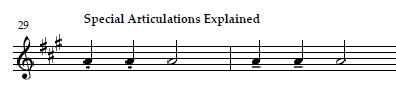


Infographics
The Musical Infographics you see to the left are ordered with titles for the information and techniques that will be covered as the video series for learning how to play Jingle Bells progresses.
The first image is the first half of the entire violin part to play the whole song. It contains a ton of information including the notes and the rhythms which the musician is to learn, as well as bowings (the direction the bow is supposed to travel, Clef, Time Signature, note durations and rests, as well as special articulations which students will learn to perform as they work through the entire lesson series.
Each of the following images is a breakdown for each pracitice point that students will need to learn to achieve to play the piece effectively.
These infographics will be explained in each module. The use of the words articulation, rhythm, staff, quarter note, eighth note and the note names will be presented in an easy and educational format by Mr. Josh and a new set of characters that are currently being created to assist in the edutainment elements of Mister Josh's neighborhood.
These characters will slowly be revealed as more of the project unfolds.
Each module should contain the elements presented here, and will review and build upon the practice capabilities for each student's success and progressive learning objectives.
Jingle Bells is a beginner level course and is the ADDIE model objective. Each of the Modules you see listed "Rhythm and Tone Practice", "Bowing Practice", and "Special Technique Cookie" are the SAM development modules that will be presented in the Jingle Bells Series. There are a few more that will also be added and which can be developed quickly to add meaning.
As students progress, they can jump into feedback communities which grant other users the opportunity to hear their progress, receive constructive criticism, and to display their current goals and achievement badges.
Research & Data
Using the skills I have learned from Applied Project Management, Contemporary Media Literacies, Design and Systems Thinking and Integrative Thinking as well as how to understand how to tell a story with data, it seems as though there are clouds of information and ideas floating around me which I can draw from to utilize methodology and the ideas of others to create an agile flow of development for my overall project. Moving forward, my starting line is to begin to utilize design thinking to create the human centric focus to solve a problem from an empathetic perspective. I always knew that I wanted to grant access to music education content to groups who do not have access to private music lessons in an engaging and meaningful way that will grant new successes and an increase in personal development. These audience members and clients are the focus of the project. The group of possible students are typically going to be those who do not have access to traditional methods of violin or music instruction. These characters are my heroes, and they are the central reason for the design. I need to provide high quality access to story-telling and pedagogy that bridges large general populations that can understand content in wholistic and from open technological sources. Using infographics seems to be the launch point for each module of content. Infographics provide broad visual medium on a visual platform such as YouTube or TikTok. They must be highly relatable, and they should provide great depth of quick conceptual and deep meaning. Digital literacy is of high impact of importance for younger generations, and they will have no issue gaining access to the platform. Combining digital literacy for younger generations with the applications that provide ease of use for older generations bridges a gap for a large population of users in the global and connected 4thIR (4th Industrial Revolution) environment. YouTube is a simple, portable application which users can take anywhere, and I can provide content they can quickly understand. I can easily serve as the guide that generates edutainment pop-ups to generate deep meaning making in an on-demand manner using just-in-time training methodology built on the design platform of long-term ADDIE, SAM and Dick and Carey educational development models. Using Integrative Thinking, I can take the system models of ADDIE, SAM, and Dick and Carey education pedagogy and curriculum development models that will highlight the strengths of each of the models to generate a process of development that utilizes a hybrid model of Traditional and Agile Project management. Here is a quasi-step by step approach of how I can see that development happening. ADDIE - Create an End Goal 18-week course based on introductory setup techniques with desired outcomes and goals. ADDIE is where Traditional Project Management Structure is utilized and forms an overview model of long-term process and goals. ADDIE relies on SAM for adaptive transition but lays a skeletal framework for where the global process is traversing. SAM – Creates and adapts short term adaptive modules that fill the 18 weeks with activities based on edutainment pop-ups and infographics that inform the process in a meaningful manner and serve as the fundamental topical center for each content module or videos. SAM is where Agile Development is most utilized. SAM relies on the skeleton of ADDIE to provide a roadmap, but SAM is the meat of the content and can adapt and change to meet the needs of the process as new problems, questions or input arises. Dick and Carey – Create an online community where users can share their progress through interactive performance and attain feedback, share experiences and attain feedback for the performance of a specific set of goals. The Dick and Carey model is the measurement tool of success and depth of understanding for personal feedback and informs where SAM and ADDIE should go, where they are weak, or where they are not working in general. Each of these developmental models serve already discovered problems and solutions previously noted in Integrative Thinking by generating content for each of the structures of content development, script writing, and marketable merchandise.
References
Baume, D., & Philpott, M. (2023). Course design, pedagogy and staff development. In D. Baume, L. Amrane-Cooper,
S. Brown, S. Hatzipanagos, P. Powell, S. Sherman, & A.
Tait (Eds.), Online and Distance Education for a
Connected World (pp. 139–166). UCL Press.
Miller, D. (2017). Building a storybrand: Clarify your message so customers will listen. HarperCollins Leadership, an imprint of HarperCollins.
Nkosinkulu, Z. (2024). Visualizing education: Infographics and pop-up edutainment exhibitions. Journal of Visual Literacy, 43(3), 250–265.
Omoregie, I., Anthony, H., & Braimoh, J. (2025). Comparative
Analysis of Instructional Models for Designing Effective
Online Courses: ADDIE, SAM, and Dick & Carey
Approaches. Journal of Languages and Translation, 5(1),
Podcasting as instruction. (n.d.). Storytelling Fellows. Retrieved
March 23, 2026, from
https://sites.uw.edu/libstory/podcasting/supplementary-
materials-for-podcasting/podcasting-as-instruction/
Voss, B. (2021). Design principles for music technology
education support: Just-in-time
learning in the recording studio using mobile technologies.
Journal of Music, Technology & Education, 14(1), 25–27.
Annotations
This article presents several models of online and distance education formats for learning environment and pedagogical development. It critiques the formats of location for in-person, online and distance learning, the methodologies used for course design and attempts to pinpoint the rationale for why certain developments to course content and pedagogical practice are implemented based on the style of synchronous or asynchronous learning environments. Through analyzing the strengths and weaknesses of each Learning Management System (LMS) whether virtual, distance or in-person, the study intends to present solutions to structure module content, enhance learning outcomes, and develop methodologies in course planning and pedagogy. It presents contrasting models of procedure based on current models and integrates solutions (IT) toward how each location, whether online, in-person, synchronous or asynchronous, provide helpful developments toward new approaches in course design with the help of technological resources and historical traditional pedagogy. One major takeaway from this article is the consideration of an agile approach to curriculum development that begins from the end. Searching for the final outcome of the modular development informs the context for each module. The article provides a great set of seven useful pedagogical principles for learning that enhance the process of complex course development modules. Principle 1: Learning is most effective when a clear structure, framework or scaffolding surrounds, supports and informs learning. Principle 2: Learning is most effective when high standards are expected of learners and are made explicit. Principle 3: Learning is most effective when learners acknowledge and use their prior learning and their particular approaches to learning. Principle 4: Learning is most effective when it is an active process. Principle 5: Learners spend lots of time on task – doing relevant things and practicing. Principle 6: Learning is most effective when it is undertaken as a collaborative activity, both among students and between students and staff Principle 7: Learning is most effective when learners receive and use feedback on their work. These principles are discussed at length with strategies for development of the use for each and under consideration of the usefulness of the experience of past and present educational models for online, distance and in-person learning, participation, and feedback.
Chapter 3 of Building a Story Brand details the 7-part Story Brand Framework. The seven steps are listed as follows and should serve purpose toward establishing direction for how to implement the educational pedagogy, modular curriculum development for purpose based on the story that I intend to develop. Further chapters provide instructional styled worksheets in a workbook format for building the story brand framework. Each Chapter asks the reader to develop the sections of the SB7 model. There are provided examples for relevance and understanding which develop concepts for how to connect with audiences and customers in a business, which in this case is a story in itself. Here are the 7 steps: 1.The Customer is the Hero, not your brand. 2.Companies tend to sell solutions to external problems, but customers buy solutions to internal problems. 3.Customers are not looking for another hero; they are looking for a guide. 4.Customers trust a guide who has a plan. 5.Customers do not take action unless they are challenged to take action. 6.Every Human being is trying to avoid a tragic ending. 7.Never assume people understand how your brand will change their lives. Tell them. This framework is where I would like to design from. I want to determine how to speak to my “Hero”. I want to show them where their problem is by speaking to them from an analysis of what my plan is. The SB7 framework is intended to display the external problem of the resources that my heroes have for the purpose of generating solutions which my heroes can internalize to overcome. Through the development of the curriculum and pedagogy, I intend to create a plan that will generate a well-defined level of success that will inspire action to find success that has not yet been attained through simple bite sized ideas and practices that generate change in their musical understanding and playing capability granting a rewarding experience toward personal success and development. This workbook will enlist a framework that helps me to identify my audience, their interests and needs, and to structure and plan content that will engage their success effectively.
Infographics are defined thoroughly throughout the article before ever placing any emphasis on edutainment pop-up aspects of the article. Infographic is defined intricately in such an inspiring way that there are at least 50 possible iterations that can be conjured up for the development of strategic curriculum based on using the most powerful sense of digital media which is vision. The contemporary media literacies (CML) elements of this project spark and come to life in this article as it displays the gaps that can be bridged to learners, providing depth and meaning through simple, bite-sized elemental educational vitamins. The retention of information provided through simple graphs and charts but that can be made interactive with modern digital tools enhances and emphasizes the strength of bridging the gap of understanding of a wide range of participating audiences. After describing the infographic as what must now be the central focus or launch point of each modular development, the article then prescribes the effects of the “pop-up edutainment” display. Here is a concept that is immersive to the senses of the learner and emphasizes the use and connection of all senses for the integration of literacy, comprehension of tough concepts and serves as a guide toward a new depth of understanding. The intent of the article bridges a gap between generational learning styles and provides avenues of literacy for generations that do not typically share learning styles. It is intent on integrating traditional education and learning styles with digital and modern learning environments. This article is pivotal in the direction of pedagogical and curriculum development for my overall project, Mr. Josh’s Neighborhood. (IT, DT, ST) Building from the platform of this design thinking and media literacy environment, it is possible to see how to integrate ADDIE and SAM educational models using digital media literacy from a perspective of traditional in-person educational development. It informs edutainment infographics for the use with the tactile home environment in the music practice realm for the development of this project.
This article provides analysis of three course design models ADDIE, SAM and the Dick and Carey models for course and online course development. ADDIE being structured and planned is very detailed and methodological, while SAM is iterative and reflects an agile response and quick development approach. The Dick and Carey Model being a model that engages three key elements of goal setting, learner analysis, and formative evaluation. In the Design Thinking approaches considering the models presented, each model presents solutions that are human focused to cover learning outcomes for differing results in both practice and pedagogy. Each system presents strengths and weaknesses for course development. ADDIE is very traditional in its design approach and uses a traditional project management style to outline course formation and design feedback and evaluation models. SAM presents an agile approach that develops as it proceeds, can be built quickly in an iterative manner but can also become shallow in its capability to present material for depth as its focus is based on agility to create content at the expense of providing the depth and detail. Its focus is speed and agility. The Dick and Carey Model is systematic and provides opportunity for measurable and specific outcomes and evaluative feedback. The intent of my usage of this model expresses my desire to understand each model better for the purpose of integrating each model (IT) for its strengths as they relate to my purposes. ADDIE presents the long-term outline, SAM presents the agile development of quick methodology and content formats to test what works and what does not in an agile manner, and Dick and Carey Model should be used to measure outcomes and results. Integrating the strengths of each should provide a well-rounded methodology for online course development and pedagogical depth with the intent to discover a manner in which to evaluate a student body which is most likely faceless, fully online, on-demand, and currently without a user community. That is, integration of Dick and Carey modular development intends to bring strength of evaluation to a platform that does not lend itself to personal interaction and evaluation. Utilization of the understanding of all three models will inevitably affect the Project Management Styles used to develop the pedagogy and delivery platforms placing value on the Hybrid model of Project Management and the Integration of each of the three pedagogical development models to integrate the strengths of each model into the presentation platform.
The University of Washington has created a program that strives to educate podcasters and video story tellers on the methodology and steps to create streamlined vlogging and digital storytelling models. There is a small wealth of knowledge to refer to on the website to gain insights into building the story lines of the podcast, design and production quality, and anywhere/anytime methods to utilize when designing and working. This is a workshop that may be useful in the future as Mr. Josh’s Neighborhood continues to develop.
The 2021 article in the journal of Music, Technology and Education centers on the theme of access to digital technology as a medium for education and skill building as individuals gain access to information through the internet, hand-held devices and apps through experiential learning provided through apps that connect users to continuously developing, step-by-step structured processes. The article references the use of just-in-time training methodology, a style of on-the-job training that is provided when and where employees and users need the information and training for the job they are doing at any given time in process rather than following a traditional model of training that teaches well rounded knowledge based pedagogy focused on preparation. This particular article focuses on just-in-time training from the perspective of music technology which is not the point of my project, but a subject I am very familiar with and from a perspective that I have absorbed it from and used to educate myself for the purpose of furthering my own career in the music technology industry. The article contains a list of seven identified design principles of a just-in-time training method for mobile learning applications, the highlight of the article which is discussed and detailed on pages 25-27 of the article. Those steps are: 1.Make use of visual information - Designers should produce interesting or “novel” ways of displaying data and other information (CML) 2.Create with modularity in mind – integrate content from existing tech or apps that perform a specific function (ST) 3.Understand the audience and how they interact with the design (DT – Human Centered) 4.Understand the mode and context of the user base which provides context for the user experience (DT) 5.The interfaces for interaction should be simple and easy to understand and should require little thought – content over complexity (DT and ST) 6.Where will the design be called upon to gain the most useful experience – (DT) 7.Implement informed user elements that reference previous designs from previous application environments to draw upon meaning from use such as Play Buttons, Volume buttons, Share and Like Buttons, etc. as examples of standardization. (DT)